
|
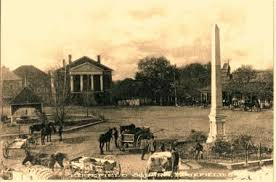
Edgefield County Probate Records
Edgefield,
South Carolina ca 1890
The county was formed in 1785 as part of Ninety Six District; parts of
Edgefield later went to form Aiken (1871), Saluda (1895), Greenwood
(1897), and McCormick (1916) counties. The county seat is the town of
Edgefield. The northern part of the Ninety Six was previously
inhabited by Cherokee Indians. The southern part adjoined the Savannah
River and was used as hunting grounds by the Creeks, Savannahs and other
tribes. Edgefield country was trafficked by white men who created a
lucrative trade with the Indians for their buffalo and beaver skins and
who exported as many as two hundred and fifty thousand skins a year
from the state. It was not until 1748 that permanent settlements were
made along the Savannah River. Families trickled in from England,
Scotland, Ireland, Wales, Germany, Holland and France as well as from
Pennsylvania, Maryland, Virginia and North Carolina. Others, forbidden
to deal in slavery, fled from Georgia to make their plantations along
the Savannah River. The first Scotch families settled on the Saluda
side of Edgefield south of Chappells Ferry. The site was located near a
hill where large chestnut trees grew. Later, the Baptist Church of
Chestnut Hill was later organized and built. They called the settlement
Scotland. Among the first Scots was Joseph Culbreath, born near
Plymouth Scotland in 1747, who was brought to Edgefield by his father,
Edward Culbreath in 1756. The father died a year later, leaving his
sons, Joseph, John, Daniel and Edward. The sons all lived to be over the
ages of 70. The family of Harry Hazel came with the Culbreaths to the
new country. In 1770 a ferry was established over the Saluda River on
the land of Robert Cunningham and another one over the Savannah River,
opposite to Augusta in Georgia. Edgefield was the site of several
Revolutionary War skirmishes and was defended by those who had settled
from North Carolina and Virginia. One such family was that of William
Abney who had settled about a mile or so from Scotland in 1772.
Nathaniel Abney served as a captain of a militia company under Major
Andrew Williamson at Ninety Six. Opposing the patriots was the Stewart
family whose homestead was located on Tosty Creek on the Saluda.
Early settlers: Peter Finson, Francis W. Pickens, Benjamin Tilman,
General Martin Witherspoon Cary, Allen Bailey, Nathan Melton, William
Daniel, William Tobler, Spencer Hawes, George Miller, Jeremiah Lamar,
Robert Gardner, David Pitts, Arthur Watson, Nathaniel Abney, Jesse
Griffin, George Bender, Michael Burkhalter, Thomas Spraggins, Mathew
Devore, Allen Burton, George Kyser, Nathaniel Bacon, Wright Nicholson,
Joseph McGinnis, John Oliphant, John Blalock, Benjamin Buzbie, Robert
Jennings, Jessy Rountree, Amos Richardson, Hezekiah Gentry, Benjamin
Hightower, Thomas turk, Stephen Garrett and others.
Edgefield county Records Available to Members of South Carolina Pioneers
- Edgefield County Wills, Bks A, B and C, 1775-1835 (abstracts)
- Index to Edgefield County Will Book D, 1836-1853
- 1817 Map of Edgefield County
Miscellaneous Edgefield County Wills, Deeds, etc. (Images and Transcripts)
- Adams, John (LWT) 1823
- Adams, John Deed to William McDaniel (1816)
- Adams, John Deed to Joel McLemore (1819)
- Adams, John Deed to Henry Anderson
- Adams, John Deed to John Hinson(1824)
- Ballentine, Hugh, 1809 Promise
- Bolger, Elizabeth
- Bush, Isaac
- Cary, William
- Ferguson, William
- Garrett, Edward
- Hagens, William
- Hamilton, William
- Hammond, Charles Sr.
- Mims, Beheatherland
- Mock, George Sr., LWT (1790)
- Morgan, Evan
- Neyle, Daniel, 1750 Land Grant
- Ramage, James
- Richardson, Jefferson
- Savage, John Land Grant, originally the Land Grant of Benjamin Harris
- Self, Daniel
- Strum, Henry Bond to Jeremiah Burnet of Liberty County, Georgia
- Sullivan, Pressly
- Swearington, Van
- Tate, Henry
- Williams, Roger
- Youngblood, Mary
Willington Academy
By Jeannette Holland Austin

During 1801 a famous school for boys was built along the banks of the
Savannah River, on the Carolina side, about forty-five miles from
Augusta and six miles from Willington. This was a time when the Broad
River joined the Savannah on the Georgia side and a wagon trail led off
into South Carolina.
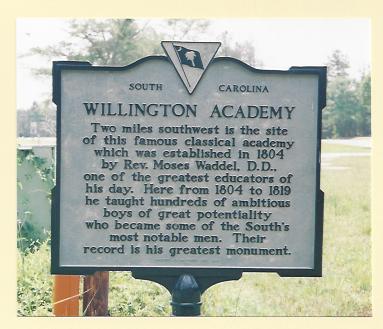 It was called the Willington School, named by his founder, Dr. Moses
Waddel. Dr. Waddel was a Presbyterian minister who later became the
president of the University of Georgia. This was a time when the basic
studies were taught in the field schools.
It was called the Willington School, named by his founder, Dr. Moses
Waddel. Dr. Waddel was a Presbyterian minister who later became the
president of the University of Georgia. This was a time when the basic
studies were taught in the field schools.
Duel at Fort Charlotte
By Jeannette Holland Austin
 William H. Crawford was kin to the Crawfords of from Virginia of
Scottish descent who settled in the backcountry in 1643, then came down
into South Carolina and Georgia. They followed the back trail and
crossed the Savannah River into Georgia. William had his early education
in the Old Field Schools, and later taught in one of those schools not
far from Augusta. Ultimately he arose to the office of Senator, then
Secretary of War and Secretary of the Treasury. He was also the chosen
candidate to run for president of the United States, however, suffered a
paralyzing stroke of apoplexy. Thus, John Quincey Adams won the
election in 1824. Crawford had political differences over a land scheme
with Peter Lawrence Van Allen with whom he fought a duel. Von Allen was
shot dead. Later on, there was a case in the Supreme Court of
Worchester vs. Georgia concerning the land scheme The affair took place
at the famous dueling ground along the Savannah River, which was the
site of old Fort Charlotte, about twelve miles below Petersburg on the
Carolina side. The fort (now in McCormick County) was built of granite
stones quarried from across the Savannah River. The northern portion of
the fort was in Oconee County across the river from Stephens County,
Georgia.
William H. Crawford was kin to the Crawfords of from Virginia of
Scottish descent who settled in the backcountry in 1643, then came down
into South Carolina and Georgia. They followed the back trail and
crossed the Savannah River into Georgia. William had his early education
in the Old Field Schools, and later taught in one of those schools not
far from Augusta. Ultimately he arose to the office of Senator, then
Secretary of War and Secretary of the Treasury. He was also the chosen
candidate to run for president of the United States, however, suffered a
paralyzing stroke of apoplexy. Thus, John Quincey Adams won the
election in 1824. Crawford had political differences over a land scheme
with Peter Lawrence Van Allen with whom he fought a duel. Von Allen was
shot dead. Later on, there was a case in the Supreme Court of
Worchester vs. Georgia concerning the land scheme The affair took place
at the famous dueling ground along the Savannah River, which was the
site of old Fort Charlotte, about twelve miles below Petersburg on the
Carolina side. The fort (now in McCormick County) was built of granite
stones quarried from across the Savannah River. The northern portion of
the fort was in Oconee County across the river from Stephens County,
Georgia.
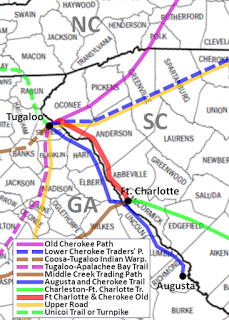
The Fort became a popular spot for gentlemen to settle their
differences. Several texts have referred to Fort Charlotte and there is
evidence that about ten duels occurred there after the Revolutionary
War. The map depicts the site as well as the old Cherokee Indian trails.

- Abbeville Co. SC Wills, Estates, Minutes, Land Grants #genealogy #southcarolinapioneers
Abbeville County Wills, Estates, Minutes, Land Grants Abbeville County
was part of Ninety-Six District where the old deed may be found. It
became Abbeville County in 1785, with parts later divided into Greenwood
(1897) and McCormick (1916) counties. The county and the county seat
were both named for the French town, Abbeville. The county was settled
primarily by Scotch-Irish and French Huguenot farmers in the
mid-eighteenth century. After the treaty with the Cherokee Indians
signed in 1777 at Dewitt's Corner (now Due West) with a flux
ofScotch-Irish and French Huguenot farmers. Abbeville played a major
role in the secession…
Follow us by Email. Just add your Email below
More South Carolina Databases
Need to know if your ancestors left a will or estate record? An easy,
quick (and free) way to find out is to click on the links below.
 County Records of 8 Genealogy Websites
Alabama
Georgia
Kentucky
North Carolina
Virginia
South Carolina
Tennessee
County Records of 8 Genealogy Websites
Alabama
Georgia
Kentucky
North Carolina
Virginia
South Carolina
Tennessee
 BUNDLE RATE for 8. Access to all eight websites plus additional data in other States: Bibles, genealogies, civil war records, colonial records, marriages, wills, estates, special collections, books written by renowned Georgia genealogist Jeannette Holland Austin.
|
Membership to 8 Genealogy Websites - Reoccurring subscription with guaranteed low rate
|
| REOCCURRING SUBSCRIPTION WITH PAYPAL = $150 per year. Guaranteed low rate so long as your subscription continues to renew itself. You may unsubscribe at any time, however, to prevent the reoccurring charge, you must "cancel" before the renewal date. To do this, login to your PayPal account and select the cancel option.
|
|
|
| About your password. Please allow up to 2 hours for your password. If not received in a timely manner, click to send reminder
|






No comments:
Post a Comment